New: autoweg has been redesigned for an even better selling experienceView news & updates
Everything about vehicle ownership transfer in Switzerland: required documents, re-registration process, cantonal fees and how to avoid mistakes. With fee calculator for all 26 cantons.

Editorial Team
The autoweg editorial team consists of Swiss automotive market experts creating in-depth guides and market analyses.
When selling a car in Switzerland, an official owner change must be completed. The seller returns the license plates to the road traffic office. The buyer registers the vehicle in their canton and receives new plates. When selling to a dealer, they handle everything.
Dealers handle the entire re-registration. No visit to the road traffic office, no forms, no waiting.
The buyer has 14 days for re-registration. Until deregistration, the seller's taxes and insurance continue.
Vehicle registration, purchase contract, license plates, ID, proof of residence (buyer) and valid vehicle inspection.
At autoweg, we process over 200 owner changes per month. The most common problem our dealer partners report? Missing documents at the road traffic office. A missing vehicle registration, an expired inspection or a forgotten proof of residence – all of this forces the buyer to return and delays the entire process by days. That's why we created this checklist: so you get everything right on your first visit.
The #1 problem with owner changes: missing documents at the road traffic office.
The owner change (or vehicle re-registration) refers to the official transfer of the registered holder in the vehicle registration at the cantonal road traffic office. The new holder is registered as the vehicle's responsible person and receives new license plates. Legal basis: Art. 11 SVG (Road Traffic Act) and Art. 73ff. VZV (Vehicle Admission Ordinance).
(55 words)
The most common cause of rejected owner changes is incomplete paperwork. If the buyer has all documents on their first visit, re-registration takes just 20-30 minutes.
Create a written purchase contract with complete details: name, address and date of birth of both parties, vehicle data (make, model, chassis number, mileage), sale price and known defects.
Use our purchase contract guide for a legally sound template.
The seller removes both license plates and returns them to their canton's road traffic office. You receive a return confirmation – this ends your liability as holder and insurance is adjusted from this date.
Return the plates on the day of sale to avoid additional costs.
Hand over the original vehicle registration, all keys, service booklet and owner's manual to the buyer. Both parties sign the purchase contract. Photograph the mileage as evidence.
Create a handover checklist so nothing is forgotten.
Notify your motor vehicle insurance in writing about the sale. Send a copy of the plate return confirmation. The premium is refunded proportionally. With comprehensive cover, this can easily be CHF 500-800.
Keep the return confirmation and insurance cancellation proof for 5 years.
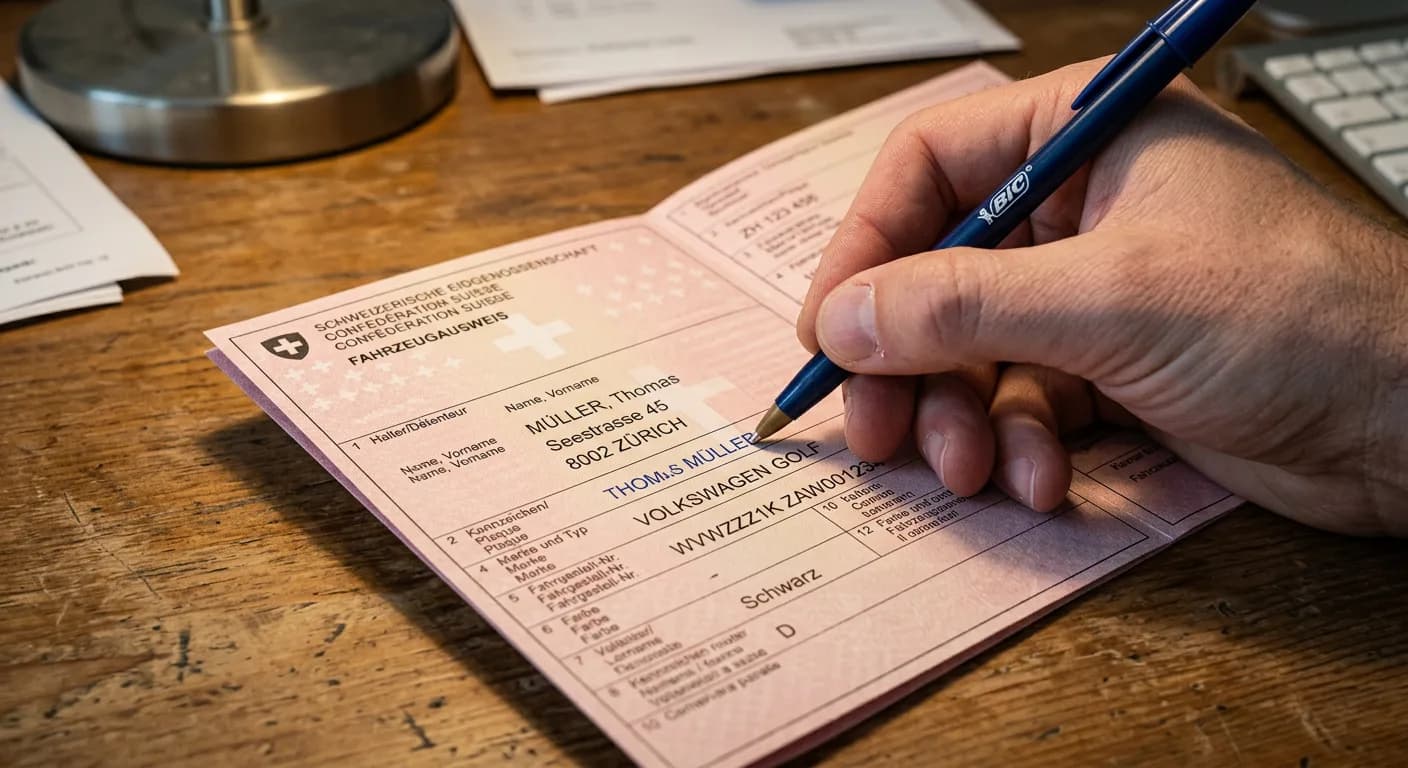
The buyer goes to their canton's road traffic office within 14 days. They need: vehicle registration, valid ID, recent proof of residence (max. 3 months old), purchase contract and proof of insurance.
In many cantons (Zurich, Bern, Basel), the buyer can book an appointment online.
After registration, the buyer receives new license plates and a new vehicle registration in their name. In most cantons this happens on the same day. Fees range from CHF 100-250 depending on canton.
The buyer can request personalised plates – additional cost of CHF 100-500 depending on canton.
Select your canton to see the exact re-registration fees.
Fees shown are based on official cantonal data and may change.
As an industry association, we see that professional handling makes the biggest difference. Dealers working with platforms like autoweg have significantly fewer problems with owner changes.
| Private Sale | Dealer Sale | autoweg | |
|---|---|---|---|
| Who handles re-registration? | Seller returns plates, buyer registers | Dealer handles everything | Dealer handles everything |
| Document preparation | You must prepare everything yourself | Dealer takes care of it | Dealer takes care of it |
| Cost to you (seller) | CHF 0 (buyer pays re-registration) | CHF 0 | CHF 0 |
| Time required | 1-2 hours + coordination | 0 minutes | 0 minutes |
| Error risk | High (missing documents, buyer doesn't re-register) | No risk | No risk |
| Warranty | You're liable under CO Art. 197 | Dealer assumes | Dealer assumes |
These mistakes cost Swiss car sellers unnecessary money and stress every year.
You give the plates to the buyer instead of returning them yourself. Result: you remain liable for insurance, taxes and all fines.
ALWAYS remove plates yourself and return them immediately to the road traffic office.
Without a purchase contract, you have no evidence in disputes about price, condition or defects. The buyer can demand cancellation or price reduction.
ALWAYS create a written purchase contract listing all known defects.
If the inspection is expired, the buyer cannot re-register. They must first pass a new inspection – additional costs and delays.
Check the inspection expiry date before the sale and inform the buyer.
Even after returning plates, you must inform insurance separately. Otherwise the policy may continue.
Send the plate return confirmation to insurance immediately.
The buyer must re-register within 14 days. Missing the deadline means driving without valid registration – which is punishable.
Note the 14-day deadline in writing in the purchase contract.
In private sales, the owner change is the biggest source of errors. Anyone who doesn't immediately return the plates risks months of costs for a car they no longer own.
These reasons most commonly prevent the owner change from being processed.
Without a valid vehicle registration, the office cannot process the re-registration. A lost registration must first be replaced with a duplicate.
Check the vehicle registration for completeness and validity before the sale.
Vehicles with an expired inspection cannot be re-registered. The inspection must be passed first.
Check the expiry date on the registration. If needed, renew before the sale.
If the seller has unpaid motor vehicle taxes or traffic fines, deregistration can be blocked.
Settle all outstanding amounts before deregistration.
The buyer needs a recent proof of residence (max. 3 months old). Without it, registration is refused.
Request proof of residence from the municipality – takes 1-5 days depending on canton.
In many cantons, the current holder must sign the vehicle registration to authorise the transfer.
Ensure the seller's signature on the vehicle registration before handover.
 Legal & Documents
Step-by-step guide to deregistering your vehicle at the road traffic office. With checklist, costs and deadlines for all 26 cantons.
Read Legal & Documents
What must be in the purchase contract? All important clauses, legal tips and what to watch out for when selling your car.
Read Insurance & Tax
When and how to cancel your insurance after selling. Calculate your refund, avoid common mistakes, and understand special termination rights.
Read