New: autoweg has been redesigned for an even better selling experienceView news & updates
What must a car purchase contract contain? All required details, important clauses, and common mistakes – with free template.

Editorial Team
The autoweg editorial team consists of Swiss automotive market experts creating in-depth guides and market analyses.
When I sold my first car privately, I was proud of myself. I had negotiated a good price for my old VW Golf – CHF 8,500 – the buyer was happy, we shook hands, and I thought the matter was settled.
Three weeks later, my phone rang. The buyer had discovered a leak on the gearbox cover during a service. The repair cost: CHF 620. And he wanted me to pay for it.
I was speechless. I had known that the gearbox leaked slightly – a small drip, barely noticeable, but there. Had I mentioned it? Verbally, yes. Had I written it in the contract? No. That was exactly my mistake.
What followed was unpleasant: phone calls, WhatsApp messages, a threat of mediation. In the end, we agreed on CHF 400 that I paid out of my own pocket – not because I was legally obligated, but because the hassle had become unbearable. On top of that came CHF 150 for legal advice.
In total, that one missing sentence in the contract cost me CHF 550. And I could have prevented it with three words: 'gearbox leaks slightly.'
That is exactly why I wrote this complete guide.
A purchase contract is a legally binding agreement between seller and buyer in which the essential conditions of a vehicle sale are recorded in writing – based on CO Art. 184 ff.
(32 words)
A purchase contract is a legally binding agreement between seller and buyer in which the essential conditions of a sale are recorded in writing. For car sales, it governs: who sells what, at what price, in what condition, under what terms – and what happens if something is wrong.
Swiss law recognises the sale as an independent contract type in the Code of Obligations (CO), Art. 184 to 236. According to CO Art. 184 para. 1, the seller undertakes to deliver the item and transfer ownership; the buyer undertakes to pay the purchase price.
The law does not prescribe any particular form for vehicle sales between private individuals – theoretically, an oral contract is valid. In practice, however, this is risky: an oral contract is nearly impossible to prove in a dispute.
A written purchase contract is effectively essential for private sales because it documents the condition at handover, defines the scope of liability, serves as the basis for re-registration, and acts as evidence in disputes.
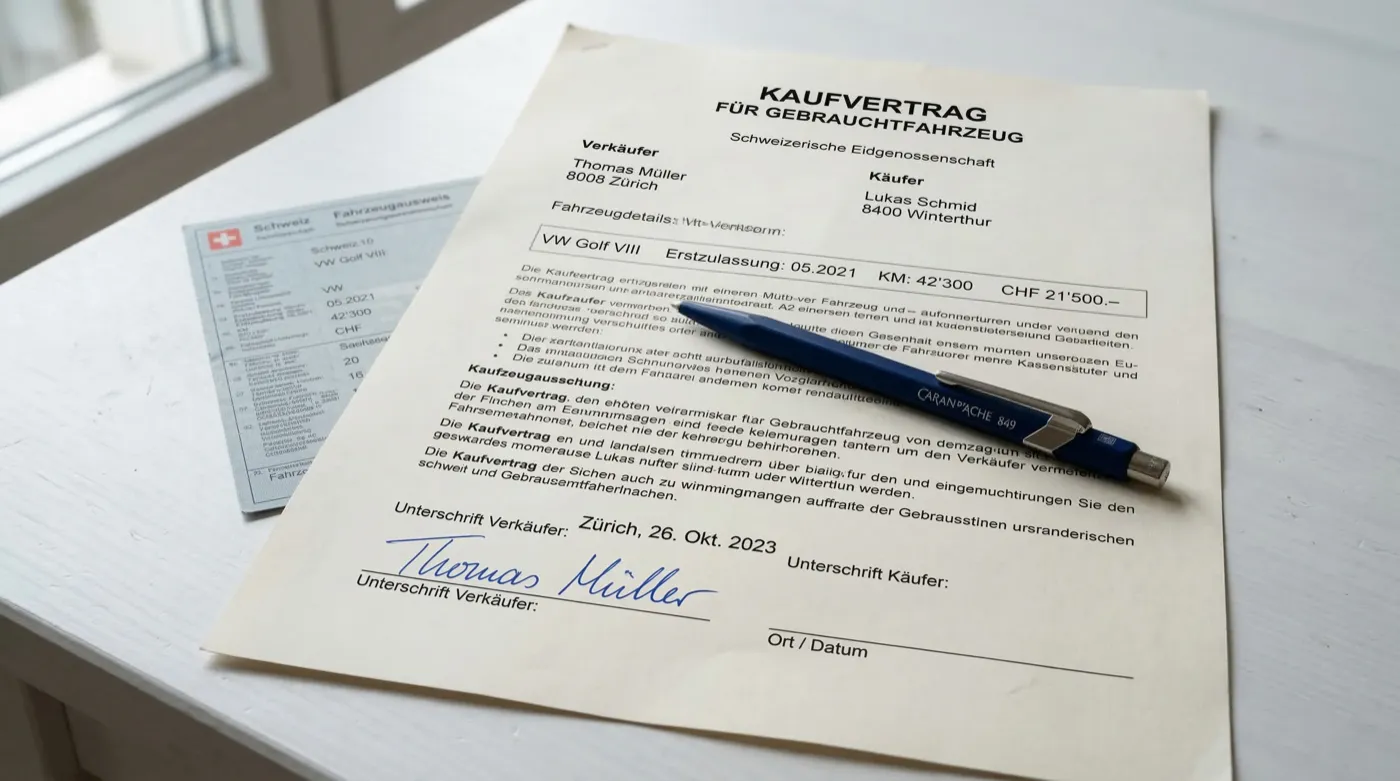
Every serious purchase contract for a vehicle in Switzerland must contain these seven elements. If even one is missing, the contract can be challenged or offers insufficient protection in a dispute.
Full name, current address, phone number, and email address of the seller. For commercial sellers: also company name and UID number.
First and last name, address, phone, and ideally a copy of an ID document. Always request valid photo identification – it is standard in every serious car transaction.
Vehicle Identification Number (VIN, 17 characters), registration number from the Swiss vehicle registration document, make, model, year, colour, fuel type, transmission type, and licence plate.
Exact mileage at the time of handover, ideally documented with a photo of the odometer. Intentional falsification is a criminal offence – forgery of documents under Art. 251 SCC.
Price in CHF (in numbers and words), payment method (cash, bank transfer, instalments), and payment date. Never hand over the vehicle before full payment.
Accident damage, known defects, pending repairs, missing documents. Fraudulent concealment renders the warranty exclusion ineffective (CO Art. 197 and 199).
Date of contract conclusion and vehicle handover. Handwritten signatures of both parties. Prepare two originals – one for each party.
Select your situation and get the appropriate contract clauses
"The vehicle is sold in its current condition without any warranty under CO Art. 197 ff. The buyer has inspected the vehicle and accepts its condition."
"The following known defects are disclosed by the seller and acknowledged by the buyer: [list defects here]. These defects are reflected in the purchase price."
"The purchase price of CHF [AMOUNT] is paid in cash at handover. The seller confirms receipt with a separate receipt."
"The vehicle is handed over on [DATE] at [TIME] at location [PLACE]. Included accessories: [LIST]. Both parties confirm the proper condition at handover."
"The buyer is liable for all self-caused damage during the test drive. A copy of the driving licence was made before the test drive."
This tool provides guidance only. For binding legal advice, consult a lawyer or TCS legal services.
'The vehicle is sold in its current condition. All warranty under CO Art. 197 ff. is expressly excluded.' Permissible in private sales as long as no defects are fraudulently concealed.
For instalment payments or cheques: register a retention of title under Art. 715 CC. Must be registered at the Debt Collection Office (CHF 25–40).
When and where the vehicle will be handed over, in what condition, and what accessories are included (winter tyres, second key, service booklet).
Separate, signed list of all included items. Typical dispute points: winter tyres, navigation SD card, second key.
Who is liable for damage during a test drive? Standard: the buyer is liable for self-caused damage. Request a copy of the driving licence.
'We agreed on that' – that is not enough in court. Everything important must be in the written contract.
'Vehicle in good condition' or 'occasional minor issues' are worthless. Either list defects precisely or make no statements at all.
A warranty exclusion without defect disclosure can be considered fraudulent concealment (BGE 121 III 306).
Accepting cash without a receipt? You will not be able to prove payment was made later.
'Engine and gearbox flawless' are guarantees that will be used against you in a dispute. Do not give guarantees you cannot back up.
A comparison of the three most common ways to sell a car in Switzerland
| Criterion | Private Sale | Dealer Purchase | autoweg.ch |
|---|---|---|---|
| Legal Security | Medium – depends on contract quality | High – professional standard contract | High – dealer handles the contract |
| Effort for Seller | High – draft, review, archive contract | Low – dealer handles everything | Minimal – you just fill in the form |
| Costs | CHF 0 (template) to CHF 300 (lawyer) | Included in vehicle price | Free for the seller |
| Standard Clauses | Only if known and inserted | All industry-standard clauses | Dealer's contract framework |
| Dispute Resolution | Justice of the Peace / court | Dealer warranty, ombudsman | Dealer is liable to the buyer |
| Time Required | 1–3 hours incl. research | 30–60 minutes | Approx. 5 minutes online form |
| Defect Protection | Only if defects correctly documented | Statutory warranty (2 years) | Dealer assumes warranty |
The purchase contract itself is uniformly regulated across Switzerland – the Code of Obligations applies everywhere. What varies from canton to canton are the procedures surrounding vehicle re-registration.
Record in the purchase contract who is responsible for re-registration and by when it must be completed.
Complete guide to re-registration in all 26 cantonsWithout explicit exclusion, the statutory defect warranty of two years applies. The buyer can demand a price reduction or cancellation for hidden defects.
Always include a clear warranty exclusion in the contract.
You know about a defect and mention it verbally. Three weeks later, the buyer denies ever hearing about it.
Every known defect must be recorded in writing in the contract or in a signed defect list.
The buyer pays cash, you hand over the vehicle. No receipt. Later they claim to have paid less.
Receipt with date, amount, vehicle description, and both signatures – always.
The buyer only transfers a deposit, takes the car, and disappears.
Only hand over the vehicle after full payment. For instalments: register retention of title (CHF 25–40).
'Approx. 185,000 km' instead of 187,000 km in the contract. The buyer feels deceived.
Always state the exact current mileage and document it with a photo of the odometer.
A purchase contract for a vehicle does not require notarisation – unlike real estate. Nevertheless, I always recommend a clear written form with a defect list and signatures. Anyone who thinks a handshake is enough risks an expensive lesson.
The most common mistake we see at TCS Legal Protection: the warranty exclusion is missing, or it was included but known defects were simultaneously concealed. Both lead to the same situation – the seller is liable.
Buyers have significantly fewer rights in private sales than when buying from a dealer. That is why a complete purchase contract is also in the buyer's interest: it documents the agreed condition and protects both parties.
A complete, clearly worded purchase contract is not a bureaucratic hurdle when selling a car privately in Switzerland – it is your most important means of protection.
 Legal & Documents
Complete process for owner change: Required documents, cantonal fees, deadlines, and common mistakes to avoid when re-registering your vehicle.
Read Legal & Documents
Step-by-step guide to deregistering your vehicle at the road traffic office. With checklist, costs and deadlines for all 26 cantons.
Read Insurance & Tax
Everything about taxes on car sales: Private vs. commercial trading, VAT obligations, and canton-specific tax regulations.
Read