New: autoweg has been redesigned for an even better selling experienceView news & updates
Compare all three options at the end of your lease contract — with concrete numbers and decision support

Editorial Team
The autoweg editorial team consists of Swiss automotive market experts creating in-depth guides and market analyses.
At the end of a lease contract, you face an important decision: return the car, buy it back, or sign a new lease agreement. This decision has financial impacts of CHF 2,000 to CHF 10,000+.
This guide compares all three options with concrete numbers, advantages and disadvantages, plus a decision framework. Discover when buyback and resale are profitable, when returning makes sense, and how to realize additional gains using the leasing arbitrage principle.
From simple return to profitable buyback — this guide gives you all the tools to make the optimal decision. With concrete examples, an interactive calculator, and expert advice.
In about 30% of lease contracts in Switzerland, the market value exceeds the residual value. This means: buying back and reselling can be extremely profitable — averaging CHF 3,000-8,000 in profit.
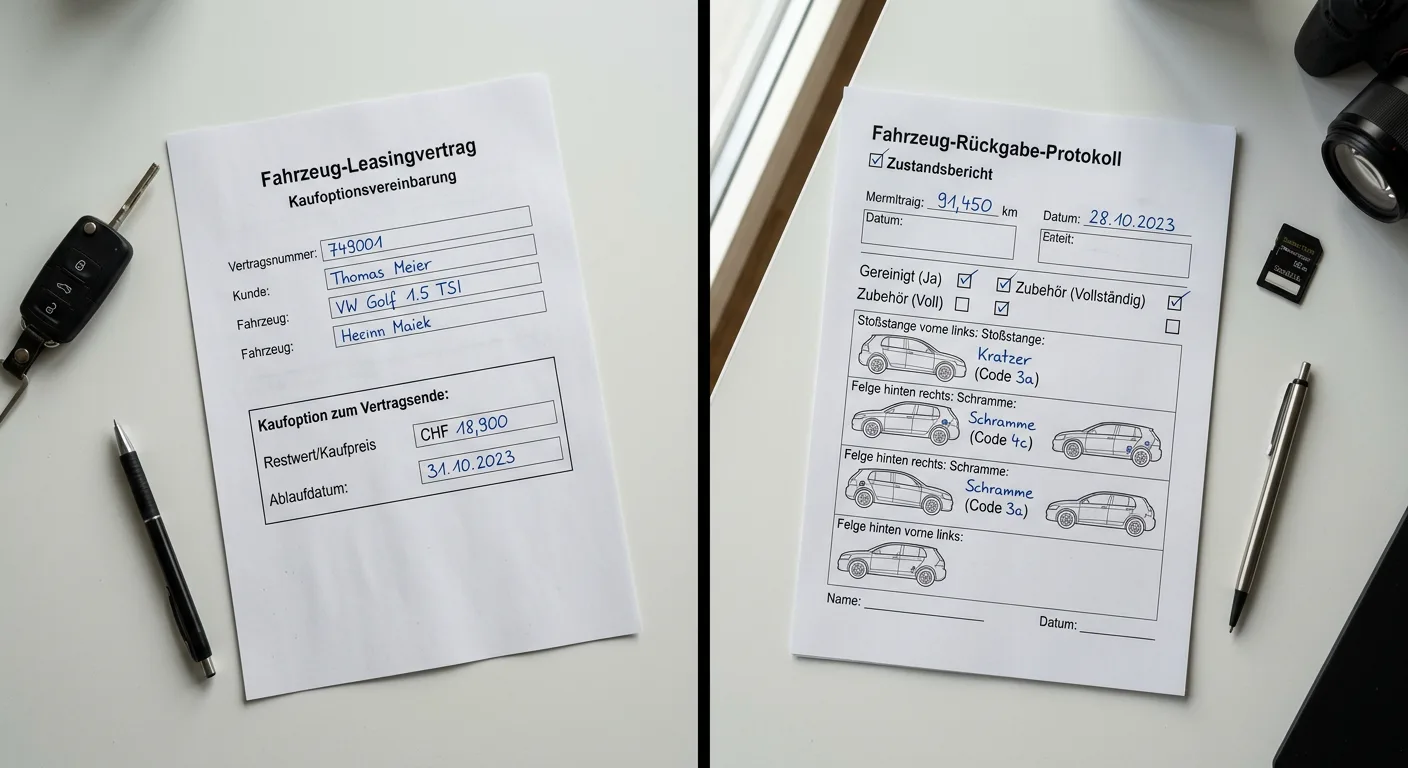
In a lease buyback, the lessee purchases the vehicle from the lessor at the end of the contract at the contractually agreed residual value. If the current market value exceeds this residual value, a positive difference arises — known as leasing arbitrage.
(42 words)
The decisive factor isn't the absolute residual value, but the difference between the residual value and current market value. For popular models like the VW Golf or Tesla Model 3, we regularly see differences of CHF 3,000 to 8,000.
The vehicle is returned at contract end. The leasing company inspects the car and sends you an invoice for damage and normal wear.
Best for: Heavily used vehicles, declining market values, or if you lack time.
You buy the car from the lessor at the residual value specified in the contract and then resell it on the market. If market value exceeds residual value, you make a profit.
Best for: Popular models with stable values, if you have capital and can invest time.
Instead of buyback or return, you directly sign a new contract with the lessor (or another), usually on attractive terms.
Best for: Lease users who prefer a hassle-free car without surprises and don't seek profits.
| Criterion | Return | Buyback & Resale | New Lease |
|---|---|---|---|
| Initial effort | Low — handover only | High — pay residual value (CHF 15,000-25,000) | Medium — down payment (CHF 2,000-5,000) |
| Potential profit/loss | CHF 0 (optimistic: -CHF 500-2,000 fees) | CHF 1,000-5,000+ profit (market value minus residual value minus costs) | CHF 0 — pure monthly payments |
| Risk | Low — known costs for damage | Medium — sales risk, market volatility | Low — predictable monthly costs |
| Time required | Minimal — 1-2 hours handover | High — 2-4 weeks sales process | Low — 2-3 hours to sign contract |
| Capital required | No — possibly fees from your pocket | Yes — CHF 10,000-25,000 for buyback | Yes, but minimal — only down payment CHF 2,000-5,000 |
| Flexibility after acquisition | High — car doesn't belong to you, new choice | Maximum — car belongs to you, free decision | Limited — contract determines use |
| Total cost over 5 years (example) | No profit, possible fees | CHF 2,000-4,000 net profit after sale | CHF 35,000-50,000 (monthly payments) |
Answer these questions in order to find your best option.
Do you know the current market value of your car and is it higher than the residual value in your contract?
→ Buyback might be profitable. Go to next question.
→ Return is probably optimal. You save effort and time.
Do you have capital for the buyback (CHF 12,000-20,000)?
→ Continue to next question.
→ Return or new lease are your options.
Do you have 2-4 weeks of time and patience for the sales process?
→ Buyback & resale is strategically sound.
→ New lease offers quick transition without effort.
Does your lease contract have a profit-sharing clause (residual value rebate)?
→ Use buyback and secure profit before clause expires.
→ All profits go to you. Buyback makes sense without restrictions.
Calculate your potential buyback profit
This calculation is an estimate. Actual costs may vary by canton and situation.
Tesla Model 3 Standard Range Plus, leased 3 years, 75,000 km, residual value CHF 15,000, current market value CHF 19,500.
Buyback & resale brings you CHF 4,425 more than return (CHF 3,225 profit vs CHF -1,200 costs).
Many lessees simply return their car without checking the market value. They often miss out on thousands of francs in profit. A 5-minute market value check can really pay off.
The buyback calculation is simple: market value minus residual value minus costs = your profit.
You need a difference of at least CHF 1,500-2,000 between market value and residual value to cover sales costs (fees, insurance, administration) and realize a true profit.
Avoid these costly mistakes with your leasing decision
Many lessees simply return the car without knowing its current market value.
Get at least 2-3 market value estimates 3 months before contract end.
CHF 3,000-8,000 in missed profit
Most contracts set a deadline of 30-90 days before contract end for the buyback declaration.
Note the deadline in your calendar and act 3 months in advance.
Loss of buyback right
Transfer fees, inspection costs, taxes, and selling commissions reduce profit.
Factor in all costs: transfer (CHF 100-200), inspection (CHF 50-100), platform (0-500 CHF).
CHF 500-1,500 in unexpected costs
Vehicle damage can drastically reduce market value and make buyback unprofitable.
Have the vehicle professionally assessed before making your decision.
CHF 1,000-5,000 in value loss
Many cling to their car or return it without checking the numbers.
Decide purely based on numbers: market value minus residual value minus costs.
Variable — often CHF 2,000-5,000
Total potential of missed profits: CHF 3,000-15,000
Marco from Zurich, Tesla Model 3 Standard Range Plus, 36-month lease
Marco checked the market value of his Tesla 3 months before contract end. The residual value was CHF 28,500, the current market value CHF 35,000. After deducting all costs (transfer CHF 150, listing CHF 200, inspection CHF 80), he achieved a net profit of CHF 6,070.
Without checking the market value, Marco would have left CHF 6,070 on the table. The 30-minute research was the best-paid work of his life.
Returning the vehicle only makes sense when the market value is below the residual value or the vehicle has significant damage. In all other cases, a buyback should at least be considered.
When I faced the decision of returning or buying back my leased car, I was surprised by how little transparent information was available. No simple calculator, no clear comparisons. So we built autoweg.ch — the platform that makes this decision simple.
Today, we help thousands of Swiss people get the most out of their lease end. Whether buyback, return, or resale — we make sure you make the best decision.
Every lessee in Switzerland should be able to make the best possible decision at contract end — without hidden costs, without time pressure, and with full transparency.
Patrick Steiner
Founder, autoweg.ch
Answers to the most important questions about buyback, return, and new contracts at lease end.
Question not listed? Contact us for personal advice.
At lease end, your decision should be based on three factors: (1) The difference between market value and residual value, (2) your available time and capital, (3) your risk tolerance.
Choose return if market value < residual value or you lack time.
Choose buyback if positive difference CHF 1,500+ and capital available.
Choose new lease if you prefer stability and don't seek profits.
Tip: Using the leasing arbitrage principle, you could realize CHF 15,000-25,000+ profit over multiple years from lease cars. Start with the pillar article 'Leasing Arbitrage Guide' for the complete strategy.
 Leasing Guides
Smart strategies for end-of-lease decisions. Calculate if buying out and selling is more profitable than just returning your leased vehicle.
Read Leasing Guides
Learn about the garage's right of first refusal when buying back a leased car. Which providers enforce it, and how to navigate it.
Read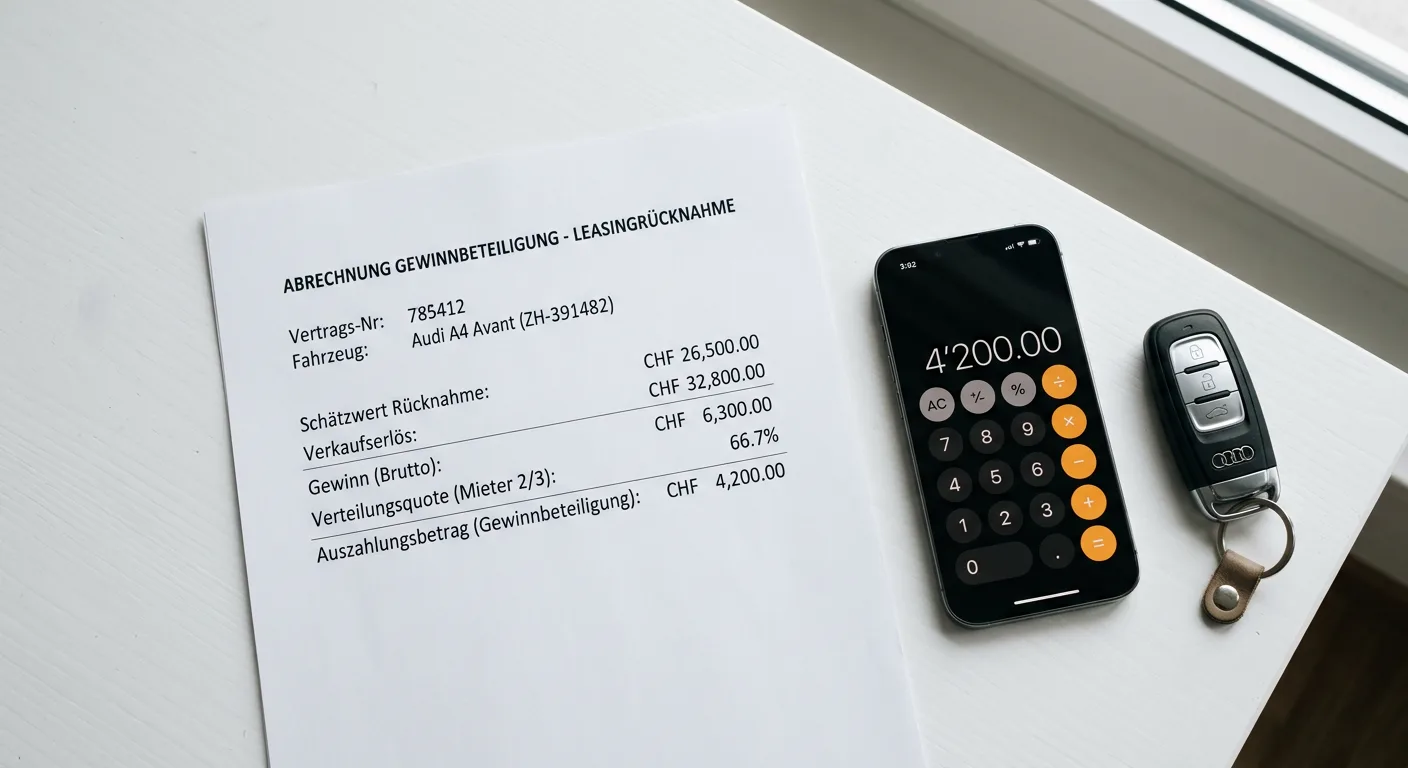 Leasing Guides
Understanding profit-sharing clauses in Swiss leasing contracts. How they work, which providers enforce them, and strategies to minimise their impact.
Read